Artificial Intelligence
Sep 7, 2026
The Observance of Labor Day and the Looming Fear of AI in the Workplace
Read More


Debates about AI in the courtroom often get stuck between two extremes. One side imagines robot judges and algorithmic verdicts. The other insists that AI has no place near sworn testimony. Both positions miss the more realistic and more useful question: what happens when AI works alongside human lawyers, with humans firmly in charge?
That question is no longer hypothetical. AI already reviews millions of documents in discovery, drafts deposition outlines, and transcribes hearings. Early experiments have pushed further, sometimes clumsily. In 2023, a consumer legal-tech company abandoned a plan to have AI coach a defendant through an earpiece in traffic court after prosecutors warned of unauthorized-practice concerns. In 2025, a New York appellate panel promptly stopped a self-represented litigant who tried to present his argument through an AI-generated avatar without telling the court. These episodes share a lesson. The problem wasn't AI's presence. It was the absence of disclosure, accountability, and a responsible human in control.
This post reimagines three uses of AI in the judicial system through a co-counsel lens: AI-assisted questioning of witnesses and jurors, AI evidence analysis with human scrutiny, and AI transcription in place of traditional stenography. It draws on legal scholarship, human-automation research, and the EQ-i 2.0 model of emotional intelligence to show how this partnership could work, and where it could still go wrong.
The phrase "co-counsel" needs careful definition. AI isn't a lawyer. It can't be licensed, can't owe fiduciary duties, and can't be disciplined by a bar association. In the model discussed here, "AI co-counsel" means a supervised AI system that participates actively in legal proceedings under the direct, continuous control of a licensed attorney who remains counsel of record.
Existing professional rules already point toward this structure. The American Bar Association's Model Rule 1.1, through its comment on technological competence, requires lawyers to understand the benefits and risks of the technology they use. Model Rule 5.3 makes lawyers responsible for supervising nonlawyer assistance, and that logic extends naturally to AI tools. In 2024, ABA Formal Opinion 512 addressed generative AI directly. It confirmed that lawyers must protect client confidentiality, verify AI output, communicate with clients about AI use where appropriate, and charge reasonable fees.
Courts also hold the authority to shape this model. Federal Rule of Evidence 611 gives judges control over the mode and order of examining witnesses. Federal Rule of Civil Procedure 47 lets courts conduct voir dire or permit the parties to do so. In practice, any AI questioning in court would happen only with judicial approval, under rules the judge sets.
The co-counsel model rests on five commitments:
Tom Tyler's research on procedural justice, presented in Why People Obey the Law, found that people accept legal outcomes largely based on whether the process felt fair. They want a voice, respectful treatment, and a neutral, trustworthy decision-maker. A witness questioned by an AI with no human present may feel processed rather than heard. The same witness questioned by AI while a human lawyer watches attentively, intervenes when needed, and treats them with visible respect has a very different experience.
Human presence signals that a person, not a system, is accountable for how the proceeding unfolds. That signal matters to witnesses, jurors, parties, and the public.
Lawyers in the room watch faces, posture, pauses, tone, and the dynamics between people. That observation is valuable, but it needs honest framing.
Research doesn't support the idea that humans, or machines, can reliably detect lies from demeanor. Charles Bond and Bella DePaulo's meta-analysis of more than 200 studies found human lie-detection accuracy of about 54 percent, barely above chance. Lisa Feldman Barrett and colleagues reviewed more than 1,000 studies and concluded that facial movements don't reliably map onto specific emotions across people and situations.
So what are human observers for? Not lie detection, but context detection. A skilled lawyer notices when a witness looks confused by a question's wording, when an elderly deponent is tiring, when a child witness is shutting down, or when a prospective juror's discomfort suggests a hardship they haven't voiced. These observations don't prove truth or falsity. They tell the human when the AI's questioning needs to slow down, rephrase, pause, or stop.
This is the clearest division of labor in the co-counsel model. AI brings consistency, recall, and analytical speed. Humans bring situational judgment and care for the person in front of them.
An override that exists on paper but fails in practice offers no protection. Decades of human-automation research explain why oversight is harder than it sounds and how to design it well.
In her classic 1983 paper "Ironies of Automation," Lisanne Bainbridge observed that the more capable an automated system becomes, the harder it is for humans to monitor it. People who passively watch a reliable system lose vigilance and skill, then must intervene in exactly the rare, difficult moments when the system fails. A lawyer who has watched AI question flawlessly for two hours may be slow to catch a damaging misstep in hour three.
Linda Skitka, Kathleen Mosier, and Mark Burdick found that people relying on automated aids often accept recommendations without enough scrutiny. They miss errors the system doesn't flag and follow advice that turns out to be wrong. Raja Parasuraman and Victor Riley called this automation "misuse." John Lee and Katrina See argued that the goal is calibrated trust, meaning reliance that matches the system's actual reliability, neither more nor less.
Madeleine Clare Elish described a "moral crumple zone," where a human operator absorbs blame for failures of a system they couldn't realistically control. Ben Green has warned that policies requiring human oversight of government algorithms can create false comfort if the humans lack the time, information, or authority to intervene.
For AI co-counsel, these findings translate into practical design requirements:
Ben Shneiderman's work on human-centered AI captures the goal: systems that combine high levels of automation and high levels of human control, rather than trading one for the other.
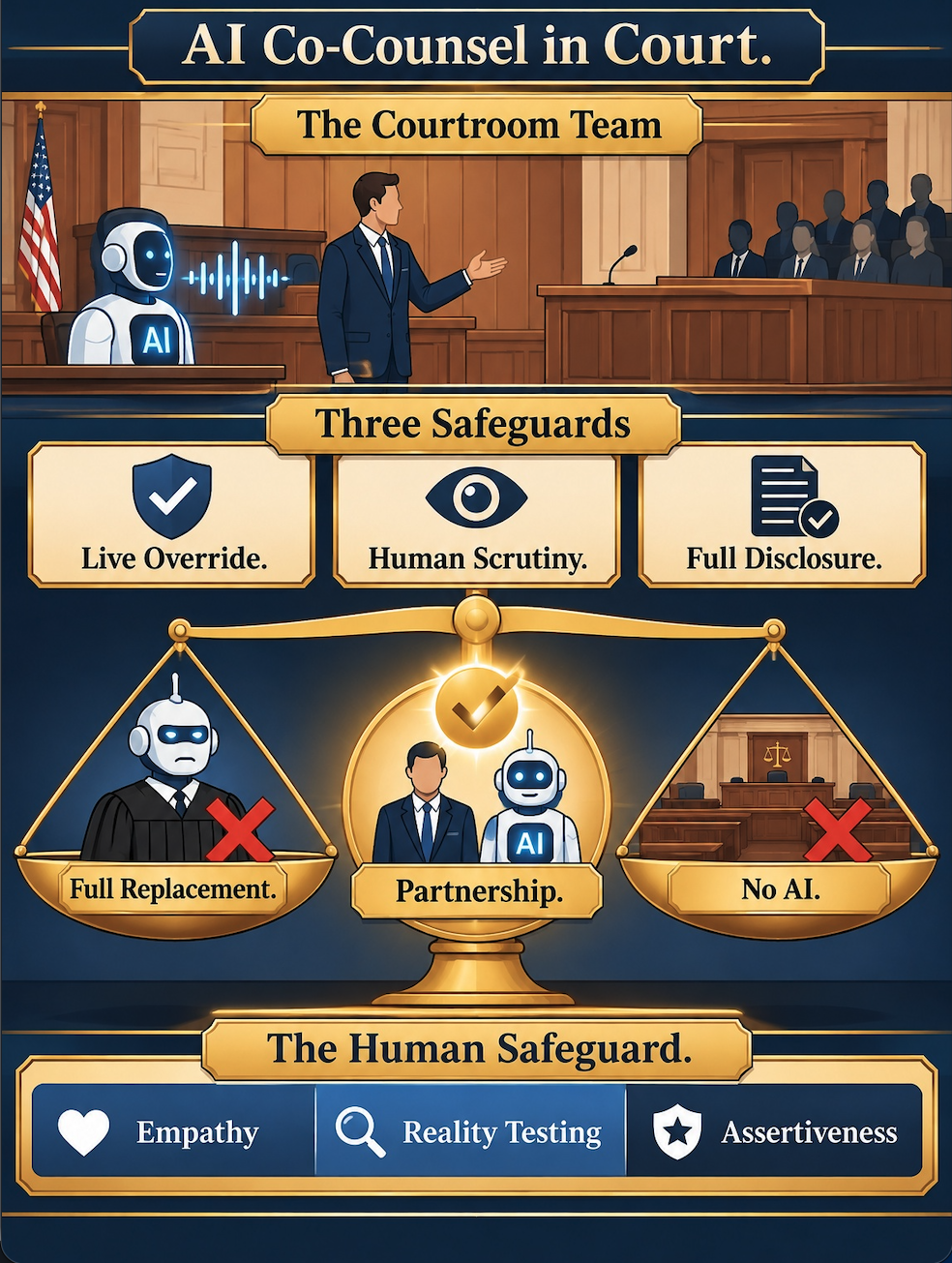
Imagine jury selection where an AI system, approved by the judge, asks each prospective juror the same baseline questions in the same neutral tone. It follows up on ambiguous answers and gently probes hardship. Meanwhile, attorneys for both sides and the judge watch from the room.
This arrangement offers real advantages:
The human role is just as concrete. A juror who answers "I can be fair" while visibly uneasy may need a gentle, private follow-up from the judge, not another scripted prompt. A lawyer who notices that the AI's phrasing confuses non-native English speakers can override and rephrase. Humans also guard against the most serious risk in jury selection: discrimination.
Batson v. Kentucky (1986) bars striking jurors based on race, yet enforcement has proven difficult. AI co-counsel could help by flagging statistical patterns in strikes for judicial review. It could also make things worse by learning proxies for race, such as neighborhood, word choice, or speech patterns. Kate Crawford and other AI ethics scholars have documented how proxy discrimination slips past surface-level safeguards. Human scrutiny of any AI-suggested strike, and judicial authority to reject it, is essential.
Depositions are a natural setting for AI-assisted questioning of witnesses. They're less formal than trial, often cover large volumes of routine facts, and consume costly attorney hours.
A co-counsel deposition might work like this. The AI handles foundational questioning about dates, documents, custodians, and chain of custody, cross-referencing answers against the record in real time. When a deponent's answer conflicts with an email from three years ago, the AI surfaces the conflict immediately. The human lawyer, watching the deponent closely, decides whether to pursue the inconsistency now, hold it for trial, or set it aside as a harmless memory lapse.
That decision requires judgment the AI doesn't have. Is the deponent being evasive, or are they an anxious executive who misremembers under pressure? Would pressing harder produce useful testimony, or hostility that hurts the client later? The human reads the room and decides.
Research on investigative interviewing supports this blended approach. Ronald Fisher and R. Edward Geiselman's cognitive interview method showed that open, rapport-based questioning produces more accurate recall than aggressive interrogation. Aldert Vrij and colleagues found that strategic questioning focused on cognitive load and verifiable details outperforms demeanor-based judgment. AI can help structure these techniques consistently. Humans maintain the rapport that makes them work.
Live AI questioning of witnesses at trial raises the hardest issues. The Sixth Amendment's Confrontation Clause guarantees criminal defendants the right to confront the witnesses against them, and courts carefully protect the integrity of cross-examination. Any AI role at trial should be narrower than in depositions, subject to strict judicial approval, and limited to areas where consistency adds clear value, such as authenticating records or walking through technical timelines.
Several safeguards matter most:
Questioning in a legal setting is a human encounter under stress. Within the EQ-i 2.0 framework, three competencies define the human lawyer's role in this partnership.
Empathy lets the lawyer recognize when a witness is frightened, grieving, or overwhelmed, and step in before the AI's consistent but tireless questioning becomes harmful. Trauma-informed practice depends on it.
Reality testing keeps the lawyer from over-interpreting what they see. A nervous witness isn't necessarily a dishonest one. An AI-flagged "inconsistency" may be an honest mistake. Reality testing means seeing the situation as it is, not as the case theory wants it to be.
Assertiveness gives the lawyer the confidence to override the AI firmly and promptly, even when the system seems to be performing well, and even when stopping it feels awkward in front of the court.
AI evidence analysis has deep roots. In Da Silva Moore v. Publicis Groupe (2012), Magistrate Judge Andrew Peck approved technology-assisted review for e-discovery. Maura Grossman and Gordon Cormack found that well-designed technology-assisted review could be more effective and more efficient than exhaustive manual review. Harry Surden's scholarship explains why: many evidentiary tasks involve pattern recognition, where machines excel.
The co-counsel model builds on this foundation. AI combs through emails, financial records, sensor data, and testimony to find patterns, contradictions, gaps, and connections. Humans then decide what those findings mean, whether they're reliable, and how they fit the legal theory of the case.
Meaningful scrutiny goes beyond skimming AI summaries. It includes:
AI could also help jurors manage complex trials through searchable databases of admitted exhibits, neutral timelines, and testimony search tools. In the co-counsel model, both parties and the judge would approve these tools before trial, and the AI would draw only from admitted evidence.
The line that must not move is this: AI never enters deliberations as a participant and never recommends a verdict. The constitutional guarantee of a jury of one's peers, affirmed in Duncan v. Louisiana (1968), reflects a commitment to community judgment that no algorithm can fulfill. Samuel Sommers found that diverse juries deliberated longer, discussed more facts, and made fewer errors than homogeneous ones. Harry Kalven and Hans Zeisel's study The American Jury showed that juries bring community values to bear in ways judges don't always share. Deliberation is where diverse human perspectives become a legitimate decision.
Automation bias remains the quiet danger. A timeline labeled "AI-generated" can seem more objective than it is, even though choosing what to include is itself a judgment. Clear jury instructions should explain that AI tools are organizational aids prepared under the court's supervision, not sources of truth.
Algorithmic risk scores offer a cautionary tale. ProPublica's 2016 investigation of the COMPAS tool reported that Black defendants were more likely to be falsely labeled high-risk. In State v. Loomis (2016), the Wisconsin Supreme Court allowed such scores in sentencing only with written warnings about their limits and barred them from being decisive. That ruling is an early example of the co-counsel principle: AI may inform, humans must decide, and the limits must be stated plainly.
AI also threatens evidence itself. Robert Chesney and Danielle Citron warned that deepfakes allow fabricated evidence to look real and give parties a "liar's dividend" to dismiss authentic evidence as fake. Federal rulemakers have proposed a new evidence rule, Rule 707, that would apply reliability standards similar to those for expert testimony to machine-generated evidence. AI co-counsel will increasingly help detect manipulation, but human experts must interpret those findings and explain them to the court.
Reality testing is the central skill here. It's the discipline to ask, "Does this AI finding actually hold up?" rather than accepting a confident output. Impulse control prevents lawyers from grabbing a dramatic AI-surfaced document before confirming its context. Social responsibility keeps fairness in view when tools perform unevenly across groups. Terry Maroney's research on judicial emotion reminds us that emotion runs through legal judgment whether we acknowledge it or not. The question isn't whether emotion is present, but whether it's managed well.
Of the three uses, AI transcription is closest to everyday reality. Federal Rule of Civil Procedure 30(b)(3) permits depositions recorded by audio, audiovisual, or stenographic means with notice. Many jurisdictions face persistent shortages of certified court reporters. AI speech recognition can produce near-instant transcripts and real-time captioning at much lower cost.
Accuracy isn't evenly distributed. Allison Koenecke and colleagues found that five leading commercial speech-recognition systems made nearly twice as many errors for Black speakers as for white speakers. Human reporters aren't perfect either. Taylor Jones and colleagues found that certified court reporters frequently mis-transcribed speakers of African American English. The honest comparison is between two imperfect systems with different failure patterns.
In the co-counsel model, transcription becomes a partnership:
The lawyers in the room add one more layer. When a lawyer hears a witness say "I didn't" and sees "I did" on the live screen, they can raise it immediately rather than discovering the error during an appeal.
Assertiveness matters here in a quiet but important way. Correcting the record means interrupting a proceeding, sometimes in front of an impatient judge. Reporters and lawyers need the confidence to say, "The transcript is wrong, and it needs to be fixed now." Empathy helps them recognize when a witness's accent, dialect, or speech difference is putting them at risk of being mis-recorded, and act to protect them.
Bringing the three scenarios together, a practical governance framework for human oversight of AI in legal proceedings includes:
This framework aligns with broader regulatory thinking. The European Union's AI Act classifies AI used in the administration of justice as high-risk, requiring human oversight, documentation, and transparency. The NIST AI Risk Management Framework emphasizes accountability, governance, and continuous measurement. Tania Sourdin's research on judicial AI similarly distinguishes supportive technologies from replacement technologies and locates the deepest legitimacy concerns at the replacement end.
The co-counsel model reduces risk but doesn't eliminate it. Three concerns deserve continued attention.
Override fatigue. As Bainbridge predicted, long periods of reliable AI performance can dull human vigilance. Rotating roles and structured breaks help.
Subtle deference. Richard Re and Alicia Solow-Niederman warned that AI could gradually push legal values toward what is measurable and away from equity and context. Even with overrides, lawyers may start thinking the way their tools think.
Resource asymmetry. Well-funded parties may deploy sophisticated AI co-counsel while public defenders and self-represented litigants cannot. Without attention to access, AI could widen existing gaps in justice rather than narrowing them.
Naming these risks isn't an argument against the partnership. It's an argument for designing it deliberately.
A clear pattern runs through every scenario. The better AI becomes at processing language and evidence, the more the system depends on the human skills that AI lacks.
Daniel Goleman's research and Reuven Bar-On's model, which underpins the EQ-i 2.0 framework, describe the competencies that make human oversight meaningful:
Courts and firms adopting AI co-counsel should invest in these skills as deliberately as they invest in the technology. Training in override protocols, trauma-informed observation, and critical review of AI output belongs in judicial education and attorney development alike. An override is only as good as the judgment and courage of the person holding it.
The co-counsel model offers a realistic middle path for AI in the judicial system:
Across all three, one principle holds. AI is a powerful instrument amplified by human oversight, not a substitute for human judgment. Let AI bring speed, memory, and consistency. Let humans bring presence, perspective, and the emotional intelligence that makes justice feel just.
What is AI co-counsel in court?
AI co-counsel is a supervised AI system that actively assists in legal proceedings by questioning witnesses, analyzing evidence, or transcribing testimony, while a licensed human lawyer remains physically present, responsible, and able to override it at any moment.
Can AI legally question witnesses or jurors in court?
Only with court permission. Judges control how witnesses are examined and how jury selection is conducted. Any AI questioning would require judicial approval, disclosure to participants, and a responsible attorney present. Live trial questioning raises Confrontation Clause concerns and should be tightly limited.
Why must human lawyers stay in the room when AI participates?
Humans observe context that AI can't reliably interpret, such as confusion, fatigue, distress, or discomfort. They protect witness dignity, catch errors, and preserve the procedural fairness that makes legal outcomes legitimate. Human presence also ensures someone is accountable.
Can AI or human lawyers detect lies from facial expressions?
No. Research shows people detect deception only slightly better than chance, and facial expressions don't reliably reveal specific emotions. Human observation is valuable for spotting when a witness needs a pause or clarification, not for judging truthfulness.
How does human oversight of AI in legal proceedings prevent mistakes?
Effective oversight combines a live override, clear triggers for intervention, validation of AI outputs, traceable sources, complete logging, and adversarial testing. These safeguards counter automation bias and keep human judgment active rather than passive.
Will AI replace court stenographers?
More likely, AI will work alongside them. AI can produce real-time drafts and captions, while a human reporter or certified reviewer monitors, corrects, and certifies the official record. Research shows both AI and humans have accuracy gaps, so a hybrid model is the safest approach.
Could AI ever help decide a verdict?
Under the co-counsel model, no. AI may organize admitted evidence for jurors under court supervision, but it never participates in deliberations or recommends outcomes. The right to a jury of one's peers requires human community judgment.
Why is emotional intelligence important for AI co-counsel?
Emotional intelligence makes oversight meaningful. Empathy protects witnesses and jurors, reality testing keeps AI output honest, and assertiveness gives humans the confidence to override and correct the system when it matters most.