Artificial Intelligence
Sep 7, 2026
The Observance of Labor Day and the Looming Fear of AI in the Workplace
Read More



On November 12, 2026, NVIDIA's Board of Directors announced that Jensen Huang had resigned as President, Chief Executive Officer, and board member, effective immediately. The departure came amid a series of reported personal scandals and followed reports that the board was preparing to remove him. Huang co-founded NVIDIA in 1993 and led it for 33 years, turning a graphics chip startup into one of the most consequential technology companies in the world.
The board moved quickly to steady the ship. Colette Kress, NVIDIA's Executive Vice President and Chief Financial Officer since 2013, agreed to serve as Interim CEO while keeping her CFO duties. Harvey C. Jones, a longtime technology executive and former CEO and Executive Chairman of Synopsys, became the company's first-ever Chair of the Board. The board has begun searching for a permanent CEO and will consider both internal and external candidates. It also stated that operations, customer commitments, and the product roadmap should continue without interruption.
Those are the facts. The harder questions are structural and strategic. Can an organization designed around one extraordinary founder function without him? And what does his exit mean for NVIDIA's place at the center of the AI economy?
To understand what's at stake, start with how NVIDIA actually worked.
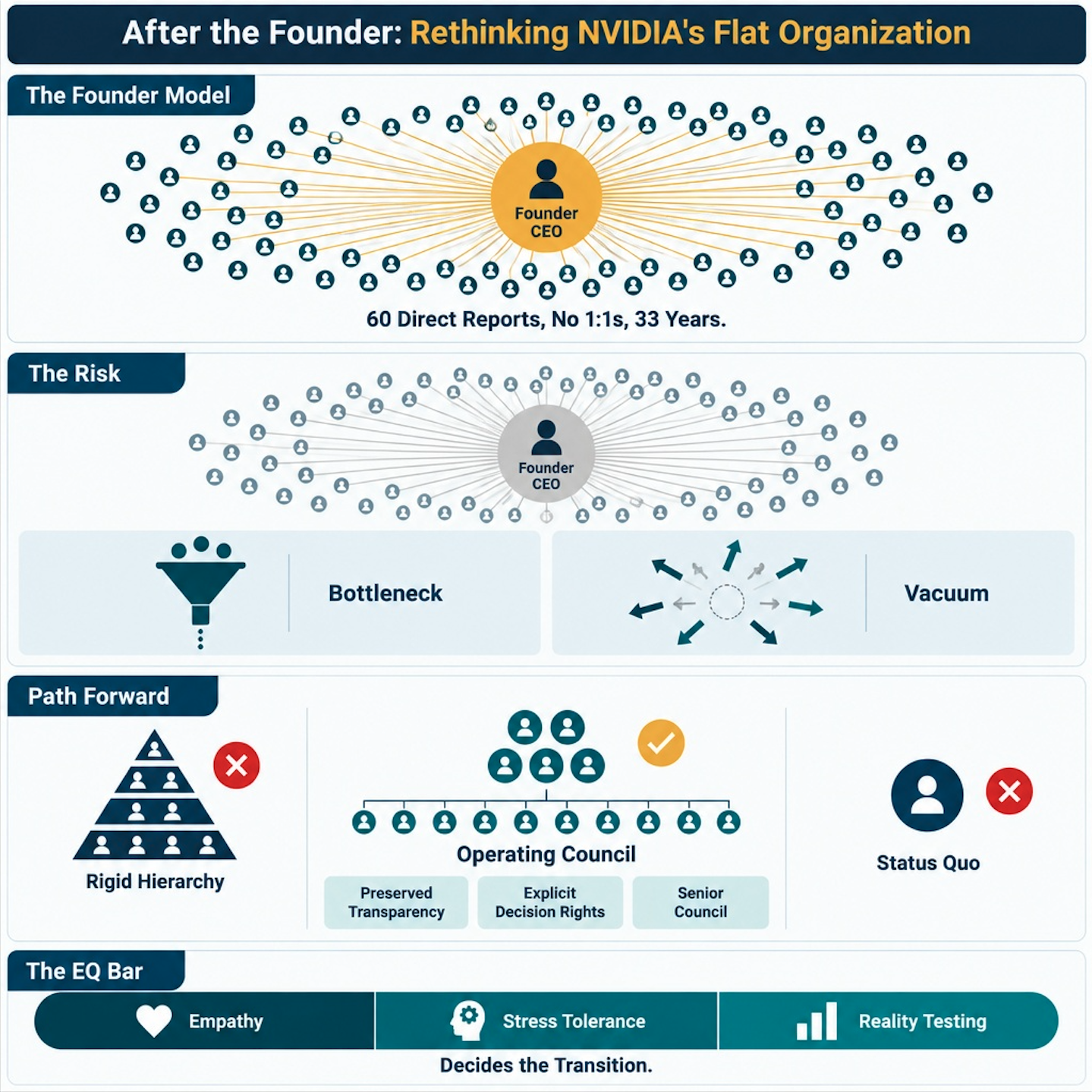
Huang famously kept about 60 direct reports, a span of control that most management textbooks would call unworkable. He also avoided routine one-on-one meetings. Instead, he preferred to share information and reason through problems in group settings, so that everyone heard the same context at the same time. Employees across the company were encouraged to send short updates on their "top five things," giving leadership a constant, ground-level view of what was happening.
Huang explained the logic in public conversations over the years. Fewer layers meant information moved faster. Group discussions meant less distortion and fewer private side deals. People with many peers and few bosses had to be self-directed, which pushed authority closer to the work. The company's guiding principle was often summarized as "the mission is the boss."
Henry Mintzberg's classic work on organizational configurations helps explain why this structure was so unusual. Mintzberg described a "simple structure," where coordination happens through direct supervision by a strong central leader. He also described an "adhocracy," a fluid, project-based design built for innovation in fast-changing environments.
NVIDIA blended both. It had the centralized vision of a simple structure, anchored by Huang, and the expert-driven, flexible teamwork of an adhocracy. That hybrid is rare at NVIDIA's scale, and Mintzberg's work suggests why. Simple structures depend heavily on the person at the center. They are fast and focused, but they are also fragile. When the central figure leaves, the coordination mechanism leaves too.
Jay Galbraith's information-processing view of organization design adds another lens. Galbraith argued that structure exists to handle uncertainty. The more uncertain the environment, the more information an organization must process, and leaders must either reduce that load or increase their capacity to handle it. Huang chose an unusual answer: he made himself the high-bandwidth processor at the center of the system. Sixty direct reports worked because one person could take in and act on an enormous volume of information.
Tom Burns and G. M. Stalker's research on "organic" versus "mechanistic" structures points in the same direction. Organic structures, with loose roles and lateral communication, tend to outperform rigid hierarchies in turbulent, innovative industries. Few industries have been more turbulent than AI computing over the past decade. NVIDIA's flat design was a deliberate fit for that environment.
Here's the critical insight: NVIDIA's flat structure was more than a design choice. It was an extension of one person's cognitive style, personal authority, and decades of accumulated trust.
Edgar Schein's research on organizational culture showed that founders shape culture more powerfully than any later leader. Their assumptions about how decisions get made, how information flows, and what behavior gets rewarded become embedded in daily routines. Huang's preference for open reasoning, rapid feedback, and broad information sharing became NVIDIA's operating system.
Donald Hambrick and Phyllis Mason's "upper echelons" theory explains why this matters for succession. Organizations become reflections of their top leaders' values and thinking patterns. When those leaders change, the organization's choices change with them, often in ways that are hard to predict.
Jim Collins captured the risk in Good to Great, where he described the "genius with a thousand helpers" model. In these companies, a brilliant leader drives performance while everyone else executes the vision. The model can produce extraordinary results, but it often falters when the genius departs, because the organization never learned to generate direction on its own.
Was NVIDIA a "genius with a thousand helpers" company? Not entirely. Its engineering talent runs deep, and its leadership team has executed at a remarkable level. Still, the 60-report structure meant that Huang personally served as the integration point for an unusually large share of the company's strategic decisions. That concentration is precisely what the next leader inherits.
The short answer is yes, in some form. But the type of restructuring matters enormously.
Span-of-control research dates back to V. A. Graicunas in 1933, who showed that the number of possible relationships a manager must manage grows dramatically with each added direct report. Huang overcame this by refusing to manage relationships one by one. He managed the group instead. That works only if the leader has the personal authority, technical depth, and stamina to run a 60-person forum productively.
A new CEO, especially one hired from outside, won't have Huang's 33 years of credibility. Sixty senior leaders who once deferred to a founder may not defer automatically to a successor. Without that authority, the flat structure risks turning into one of two failure modes: a bottleneck, where everything waits on the new CEO, or a vacuum, where 60 leaders pursue 60 separate agendas.
Research on "flattened" firms reinforces the concern. Raghuram Rajan and Julie Wulf documented how large U.S. companies widened CEO spans of control over recent decades. Wulf's later work found that flattening often concentrated decision-making at the top rather than pushing it down. In other words, flat structures frequently depend on a powerful center more than they appear to. Remove the center, and the design loses its anchor.
The opposite move carries its own danger. Rebuilding NVIDIA into a classic multi-layer hierarchy would likely slow decisions, filter information, and frustrate the engineers who chose NVIDIA for its speed and autonomy. Burns and Stalker's research suggests that mechanistic structures struggle in exactly the kind of fast-moving market NVIDIA competes in.
Alfred Chandler's foundational principle that "structure follows strategy" offers the right test. The question isn't which structure looks most conventional. It's which structure best serves NVIDIA's strategy of continuous, full-stack innovation in accelerated computing.
The most promising option is a modest restructuring that keeps NVIDIA's strengths while reducing dependence on any single person:
This approach respects what Mintzberg called the fit between configuration and environment. It shifts NVIDIA from a founder-centered simple structure toward a more durable adhocracy that can operate without one irreplaceable node.
A crucial point often gets lost in the rush to analyze. The interim CEO's job is stability, not transformation.
Colette Kress brings deep knowledge of NVIDIA's finances, customers, and operations, along with long-standing credibility with investors. Those are exactly the strengths an interim leader needs. Yet holding both the CEO and CFO roles is demanding, and an interim leader rarely has the mandate to redesign the company.
John Gabarro's research on how executives "take charge" found that new leaders move through predictable stages: learning, early action, deeper reshaping, and consolidation. Major structural moves made before the learning stage tend to backfire. Michael Watkins's work on leadership transitions reaches a similar conclusion. The first priority is diagnosis, not disruption.
For NVIDIA, that suggests a clear sequence. During the interim period, preserve the existing structure, keep information flowing, and reassure key talent and customers. Leave major restructuring to the permanent CEO, who will need both the authority and the time horizon to own it.
Noam Wasserman's research on founder-CEO succession describes a "paradox of entrepreneurial success": the very milestones that signal a founder's success often trigger their replacement. Founder transitions are among the most delicate moments in a company's life. Several risks stand out for NVIDIA:
Transitions also open doors that stay closed during a founder's tenure:
NVIDIA's position in AI rests on more than its former CEO. Its CUDA software platform, introduced in 2006, created a developer ecosystem that took nearly two decades to build. Millions of developers, research labs, and enterprises have written code for it. Its networking technology, system-level designs, and supply chain relationships form a full-stack advantage that competitors have struggled to match.
David Teece, Gary Pisano, and Amy Shuen's theory of dynamic capabilities explains why these assets matter. Durable competitive advantage comes from resources that are valuable, hard to copy, and embedded in organizational routines. NVIDIA's ecosystem fits that description. It will not vanish because a CEO departs.
Teece also described three dynamic capabilities: sensing new opportunities, seizing them with decisive investment, and transforming the organization to capture value. At NVIDIA, Huang personally embodied much of the sensing function. He placed early bets on GPU computing for science, on deep learning, and on full data center systems long before the market rewarded them. He was also the company's chief evangelist, shaping how customers, partners, and investors understood the future of accelerated computing.
That's the real exposure. NVIDIA's execution engine can keep running. The open question is whether the company can keep seeing around corners without the person who did so for three decades.
The timing adds pressure. Rival chipmakers are pushing hard, and major cloud providers continue developing custom AI silicon. Customers making multi-year infrastructure commitments want confidence in long-term roadmaps. The circumstances of the departure also bring reputational scrutiny that the new leadership must address with transparency and care.
Still, history suggests that strong platforms can outlast founder exits when the transition is handled well. The decisive variables are leadership continuity, talent retention, and the credibility of the next CEO's vision. All three depend heavily on how leaders manage people, not just strategy.
Founder transitions are emotional events. Employees may feel shock, loss, uncertainty, or anxiety about their own futures. Some will feel loyalty to the departed leader. Others may feel relief or ambition. Customers and partners will watch for signs of instability. Investors will react to every signal.
Daniel Goleman's research showed that leaders' emotional competencies strongly influence organizational climate and performance. Reuven Bar-On's model, which underpins the EQ-i 2.0 framework, organizes these competencies into five areas. Each one maps directly onto what NVIDIA's leadership needs now.
The incoming CEO's self-regard and emotional self-awareness will be tested immediately. A successor who tries to become Jensen Huang will likely fail. One who understands their own strengths, and designs structures that fit them, has a better chance. Healthy self-regard allows a leader to say, "I won't run 60 direct reports, and that's a strength, not a weakness."
Assertiveness and emotional expression let leaders communicate clearly about what will change and what won't. Uncertainty fuels anxiety more than bad news does. Employees need specific, honest answers about structure, priorities, and their roles. Independence helps a new CEO make decisions without seeking constant approval from a founder's lingering shadow.
Empathy helps leaders recognize that people grieve the end of an era, even when the departure involves controversy. Interpersonal relationships determine whether senior engineers choose to stay. Social responsibility matters especially here, because a departure tied to conduct concerns raises questions about values and trust. Leaders who model integrity and respect help restore confidence.
Reality testing keeps leaders grounded when market reactions, media coverage, and internal rumors distort the picture. Impulse control prevents rushed restructuring just to signal decisiveness. Problem solving that weighs both emotional and operational data produces more durable choices.
Stress tolerance allows leaders to perform under intense public pressure. Flexibility lets them adjust plans as new information emerges. Optimism, grounded in NVIDIA's real strengths, gives employees a credible reason to believe in the future.
John Kotter's research on leading change reinforces the point. Transformations most often stall because leaders underestimate the human side: urgency, communication, coalition-building, and the emotional work of letting go of the past. William Bridges made a similar distinction between change, which is external, and transition, which is the internal psychological process people move through. A restructuring announcement is a change. Helping thousands of employees accept it is a transition, and transitions are led with emotional intelligence.
Amy Edmondson's research on psychological safety adds one more layer. Huang's open-forum style depended on people feeling free to speak up. A new leader who preserves that safety keeps the information flowing. One who loses it will find the organization quietly going silent, regardless of how the org chart looks.
Bringing the research together, a disciplined transition might follow these steps:
NVIDIA's situation is extreme, but the lesson is universal. Many founder-led companies run on structures that quietly depend on one person's judgment, memory, and relationships. Those structures can be brilliant while the founder is present and brittle the moment they leave.
Founders and executive teams can prepare now. Build leadership depth before you need it. Write down how decisions get made. Separate governance from management. Most of all, develop emotional intelligence across the leadership team, because the day a founder exits is the day the organization's emotional resilience gets tested in public.
If your organization's greatest strength is built around one person's brilliance, have you created a company that can thrive without them, or only one that thrives because of them?
Why did Jensen Huang have about 60 direct reports?
Huang believed fewer management layers meant faster decisions and less distorted information. He shared context in group settings rather than one-on-one meetings, so leaders across NVIDIA heard the same information at the same time and could act independently.
Will NVIDIA need to restructure after Jensen Huang's resignation?
Most likely, yes, but modestly. A successor will probably lack the founder's authority to manage 60 direct reports effectively. A small senior operating council, paired with preserved transparency practices, offers a middle path between rigid hierarchy and an unsustainable flat design.
Who is leading NVIDIA now?
Colette Kress, NVIDIA's Executive Vice President and Chief Financial Officer, is serving as Interim CEO while continuing as CFO. Harvey C. Jones was appointed the company's first-ever Chair of the Board, and the board is searching for a permanent CEO.
Does Jensen Huang's departure threaten NVIDIA's leadership in AI?
It creates real uncertainty but doesn't erase NVIDIA's core advantages, including its CUDA ecosystem, full-stack systems, and customer relationships. The greater risk lies in losing Huang's ability to anticipate future markets and in potential talent departures.
Why is emotional intelligence important in a CEO transition?
Founder transitions trigger anxiety, loss, and uncertainty across the organization. Emotional intelligence helps leaders communicate honestly, retain key talent, make grounded decisions under pressure, and preserve the psychological safety that drives innovation.
What is the "genius with a thousand helpers" problem?
Jim Collins used this phrase to describe companies that depend on one brilliant leader while others execute the vision. These organizations often struggle after that leader departs because they never developed the capacity to generate direction independently.