Artificial Intelligence
Sep 7, 2026
The Observance of Labor Day and the Looming Fear of AI in the Workplace
Read More



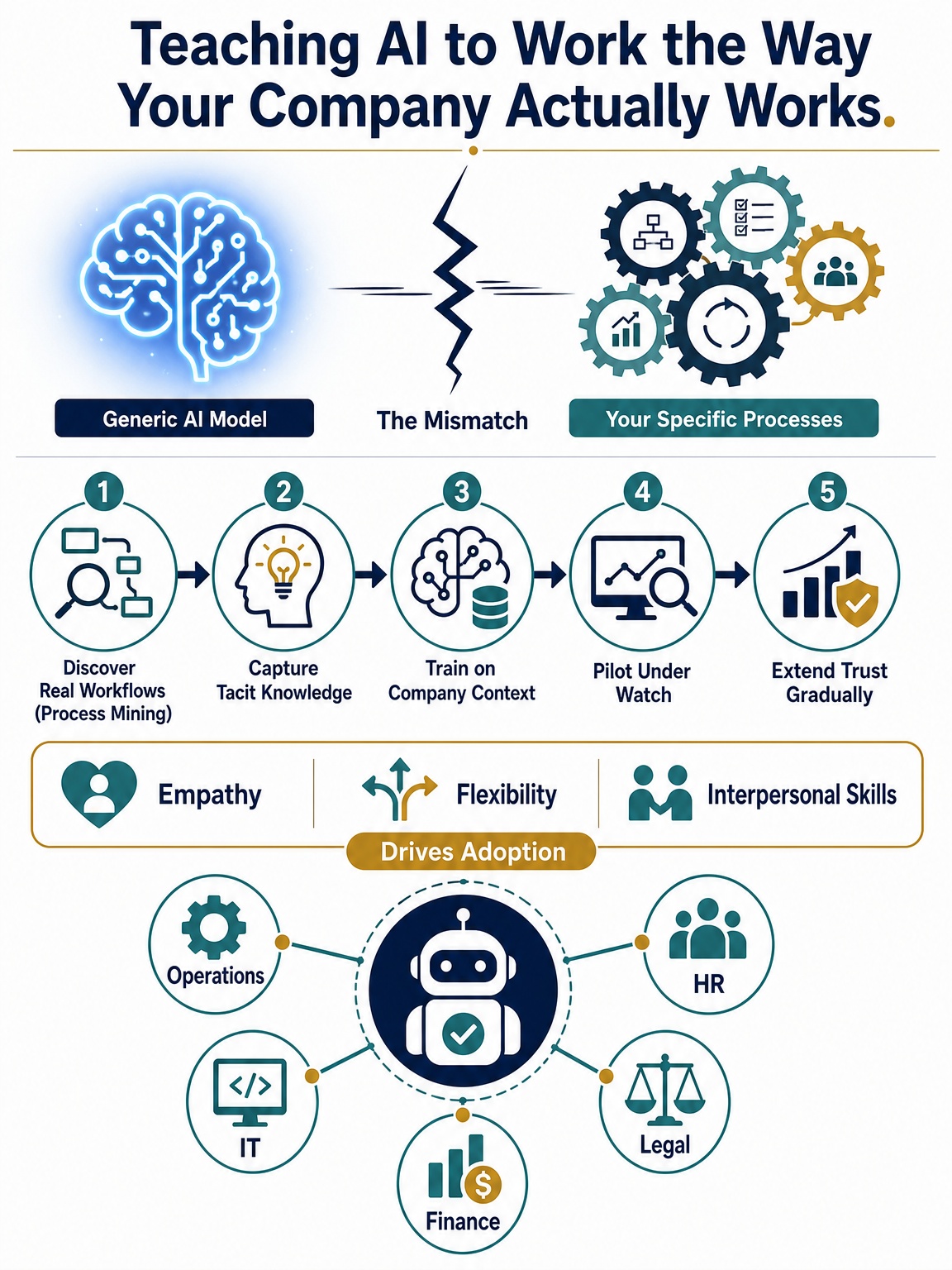
A large language model is trained on a vast slice of human knowledge. It has read about accounting, but it has never closed your books. It understands hiring in the abstract, but it has never navigated your approval chain, your spending thresholds, or the unwritten rule that a founder always eyes any deal above a certain size before it goes out the door.
That's the heart of the challenge. Company processes are specific, layered and often undocumented. They live in habits, exceptions and the judgment of experienced people who have been doing the work for years. A generic AI dropped into that environment behaves like a brilliant new hire on day one: capable in theory, lost in practice.
You already know this instinct as a leader. When you bring someone senior into your company, raw talent is only half the equation. A person can have an impeccable track record and still stumble because they don't grasp how your organization actually operates. By that I mean its decision rhythms, its culture, the informal ways things really get approved. The strongest additions to a team succeed because they fit, not just because they're skilled. Deploying AI agents demands the same discipline. Capability alone guarantees nothing. Fit is everything.
So the real questions shift. It's no longer "How smart is this model?" It becomes "How well does this agent understand the specific way we work? Can it operate within that reality responsibly?" Answering that requires a structured approach to enterprise AI process learning. It's one that respects how much of your operation lives in places a model can't simply read.
Before an AI agent can run a process, someone has to understand that process honestly. And here's the uncomfortable truth many leadership teams discover: the way work actually happens rarely matches the flowchart in the onboarding deck.
Process mining is the practice of reconstructing how work truly flows by analyzing the digital footprints your systems already generate. Every approval, timestamp, ticket and handoff leaves a trace in your ERP, CRM and workflow tools. Process mining stitches those traces together into a factual map of your operations.
This matters because documented processes describe intention, while mined processes reveal reality. A procurement workflow might officially involve three approvals. Mining often shows that in practice, half the requests skip a step, a quarter get rerouted through an unofficial shortcut, and a small but costly fraction stall for weeks in someone's inbox. As a founder or executive, you've probably suspected as much. Process mining turns that suspicion into evidence you can act on.
You cannot automate what you don't understand. Process discovery gives you the ground truth needed to build process-aware AI agents that reflect how the business really runs; not how someone once imagined it would on a whiteboard.
Mining reveals the what and the when. It struggles with the why. Why does finance personally review certain deals? Why does the operations team hold shipments until a particular check clears, even though no policy requires it?
That reasoning lives in people's heads. Capturing it requires structured conversations with the employees who own the work. The kind of interviewing and genuine listening that surfaces the judgment behind the steps. This is where empathy enters the technical process, and it's not a soft add-on. If the people who understand a workflow feel interrogated or threatened, they'll hand you the sanitized version. If they feel heard and respected, they'll share the exceptions, the workarounds and the hard-won wisdom that makes the process actually function.
Drawing on the principles of emotional intelligence, such as empathy and interpersonal relationships are precisely the competencies that unlock this knowledge. Leaders who approach process discovery with genuine curiosity, rather than a checklist, gather far richer information. This is especially true in founder-led companies, where so much institutional knowledge sits in a handful of long-tenured people. The quality of your AI agent depends directly on the quality of what those people are willing to tell you.
With an honest map of your processes and the reasoning behind them, you can begin turning a generic model into a specialized operator. This is the heart of AI workflow automation done well. It is also where many rushed deployments quietly go wrong.
The first training move is to feed the agent your specific context: your policies, your data schemas, your terminology, your decision rules. Techniques like retrieval-augmented generation let an agent consult your actual documentation and records before it acts, so its outputs reflect your reality rather than generic assumptions. When the agent handles an invoice, it should reference your approval matrix, not a textbook idea of how invoices usually work.
For a growing company, this grounding is what prevents the agent from confidently doing the wrong thing at scale. A generic answer applied to one email is a nuisance. A generic answer applied to ten thousand transactions is a serious liability.
A well-designed agent needs a clear job description, exactly like a human hire. Spell out what it can decide alone, what requires sign-off and when it must escalate to a person. This is where you translate the tacit knowledge you captured into explicit rules. If your experienced staff always escalate unusual cases, the agent should too.
Escalation design deserves special care. The goal isn't an agent that acts confidently at all times. It's an agent that knows the edges of its competence and hands off gracefully when it reaches them. A little humility engineered into the system prevents a great deal of downstream damage. And, downstream damage is far more expensive for a lean, fast-moving company than a few extra escalations.
No sensible leader gives a brand-new senior hire full authority on day one. The same probationary logic applies to AI agents. Start with a narrow, well-monitored slice of a process. Watch how the agent performs against real cases. Compare its decisions to those of experienced staff. Look for where it drifts, misreads context or misses an exception your people would have caught instinctively.
This piloting phase is diagnostic. It tells you whether the agent genuinely learned your workflow or merely learned to imitate its surface. The gap between those two is exactly where operational risk hides. For a company where reputation and momentum matter enormously, that gap is worth finding early.
Processes change, and so must the agents that run them. Build a continuous loop where human corrections feed back into the agent's behavior. When a person overrides an agent's decision, that override is a true teaching moment, not just a fix. Over time, this loop lets the agent absorb the evolving reality of your operations, keeping it aligned as your priorities, markets, and strategy shift. And make no mistake, in a scaling company, they will, constantly.
Once an agent has learned a process and proven itself in a pilot, you can gradually expand its authority to actually run operations. The transition from observer to operator should be deliberate and staged.
Think of it as a graduated trust model. Early on, the agent recommends and a human approves. As confidence grows, the agent acts within tight limits while people monitor. Eventually, for well-understood, lower-risk decisions, the agent operates autonomously with periodic review. Higher stakes or ambiguous decisions stay with people or trigger mandatory human sign-off.
This staged approach mirrors how strong founders build capable teams. You don't hand a new leader the keys to the whole operation immediately. You extend responsibility as they demonstrate judgment and fitness. Agentic AI deserves the same measured escalation of trust. Because trust that's earned incrementally is far more durable than trust that is simply assumed.
When this is done right, the payoff is substantial and directly relevant to any leader watching burn rate and headcount efficiency. A process aware AI agent can handle high-volume, rules heavy work around the clock, freeing your best people for the judgment calls, relationships, and strategic thinking that machines can't replicate. That is the real promise: not replacing your team, but redirecting its energy toward the work that actually moves your company forward.
None of this works without governance. As agents take on more operational authority, the question of accountability becomes urgent. Who is responsible when an autonomous agent makes a consequential error? The answer must be a named person, not a diffuse committee. This is a principle founders understand instinctively, because clear ownership is how anything gets done in a growing company.
Strong enterprise AI governance addresses several essentials:
Governance is not bureaucracy for its own sake. It's the infrastructure of trust. Without it, a single agent error can erode confidence across your whole organization and invite regulatory scrutiny. This would be an especially painful risk for a company still building its reputation. With it, you can scale automation while keeping risk contained. Frameworks such as the NIST AI Risk Management Framework offer useful principles for structuring this oversight. Additionally, increasing legislation like the EU AI Act makes such structure a compliance necessity rather than a nicety.
Here's the insight that surprises most technical teams and even many seasoned executives: the hardest part of deploying process-aware AI agents isn't the technology. It's the people. And that's where emotional intelligence becomes a decisive leadership competency.
When you introduce an AI agent into a workflow, you change how humans experience their work. Some feel excited. Many feel anxious. A few feel threatened, convinced the agent is the first step toward eliminating their role. If leaders ignore those emotions, adoption will stall, no matter how well the agent performs. People quietly withhold cooperation, protect their knowledge, or work around the system entirely. In a small or mid-sized company, where culture is intimate and every voice carries weight, that resistance can sink an initiative fast.
This is the same dynamic that determines whether major organizational transitions succeed or fail. In mergers and acquisitions, the deals that unravel rarely fail on the spreadsheet. They fail on the human side. The cultural clashes, change resistance and eroding trust are factors that can lead to an M&A catastrophe. The research on M&A is clear: emotionally intelligent leadership is what transforms those human obstacles into opportunities for alignment. The very same competencies apply directly to integrating AI agents into your existing team.
Drawing again on the principles of emotional intelligence, several competencies stand out for founders and executive leaders guiding this change:
The pattern is consistent. Technical excellence gets you a capable agent. Emotional intelligence gets you an organization that actually uses it. One without the other produces expensive shelfware. And few things sting a resource conscious leader more than paying for capability nobody adopts.
Because process aware AI agents touch nearly every part of the business, no single function can own their deployment alone. The people who understand the process, the people who build the agent, and the people who govern it must work as one team. For founders, this is a familiar orchestration challenge. It's the same one you face whenever a decision cuts across the whole company.
Operations own the workflow reality. IT owns integration, security and technical performance. HR aligns agent behavior with conduct standards and helps the team adapt. Legal and compliance ensure deployments meet regulatory requirements. Finance validates that costs and productivity gains hold up against consistent benchmarks. Each function contributes a distinct and necessary perspective.
This kind of simultaneous alignment is exactly the work executive leaders do best: balancing many stakeholders toward a single successful outcome. When these functions collaborate well, agents integrate smoothly. When they operate in silos, gaps appear exactly where the disciplines fail to connect. And those gaps, are where failures live. Setting the expectation of cross functional ownership from the top is one of the highest leverage things a founder can do to make AI adoption stick.
The path from generic model to reliable digital operator is not a single leap. It's a disciplined sequence: discover how work truly happens, capture the reasoning behind it, train the agent on your specific context, pilot under close watch, expand authority gradually, govern rigorously, and lead the human side with genuine emotional intelligence.
Companies that rush buying powerful models and expecting instant transformation tend to end up with impressive technology that never fits. Companies that treat AI deployment with the same rigor they'd apply to a critical senior hire (i.e. assessing fit, extending trust in stages, and attending carefully to the humans involved) build something durable. They create agents that don't just know things in general, but know how their company works in particular.
That distinction between generic capability and specific fit, will separate the leaders who merely adopt AI from those who genuinely master it. And in the years ahead, it may well separate the companies that scale from those that stall.
What are process-aware AI agents?
Process-aware AI agents are AI systems trained to understand and operate within a specific company's actual workflows, rather than relying on generic assumptions. They learn how work truly happens in your organization, then execute or support that work within defined boundaries and governance.
Why do generic AI models struggle with company specific processes?
Generic models are trained on broad, general knowledge. They understand concepts in the abstract but have no knowledge of your particular policies, terminology, approval chains, exceptions or undocumented practices. Without that specific context, they behave capably in theory but poorly in real operations.
What is process mining and why does it matter?
Process mining reconstructs how work actually flows by analyzing the digital records your systems already generate, such as timestamps, approvals, handoffs, and tickets. It matters because it reveals the reality of your operations, which often differs sharply from the documented version. This gives you the honest foundation needed to build effective AI agents.
How does emotional intelligence affect AI agent deployment?
Emotional intelligence shapes whether people cooperate with or resist new AI agents. Empathy unlocks the honest process knowledge that makes agents accurate, flexibility keeps rollouts adaptive, and strong interpersonal skills build the trust that drives adoption. Technical excellence produces a capable agent; emotional intelligence produces an organization willing to use it.
How should a company decide how much authority to give an AI agent?
Use a graduated trust model. Begin with the agent recommending and humans approving, then allow limited autonomous action under monitoring, and reserve full autonomy for well-understood, lower-risk decisions. Higher-stakes or ambiguous decisions should remain with people or require human sign-off, all under clear governance and accountability.
What governance is needed for AI agents running operations?
Essential elements include clear decision authority limits, detailed audit trails, bias and fairness monitoring, performance drift detection, and a named executive accountable for each agent's outcomes. Frameworks like the NIST AI Risk Management Framework and regulations such as the EU AI Act offer useful guidance for structuring this oversight.