Jan 2, 2026
Why Avoiding Conflict Costs You More
Read More


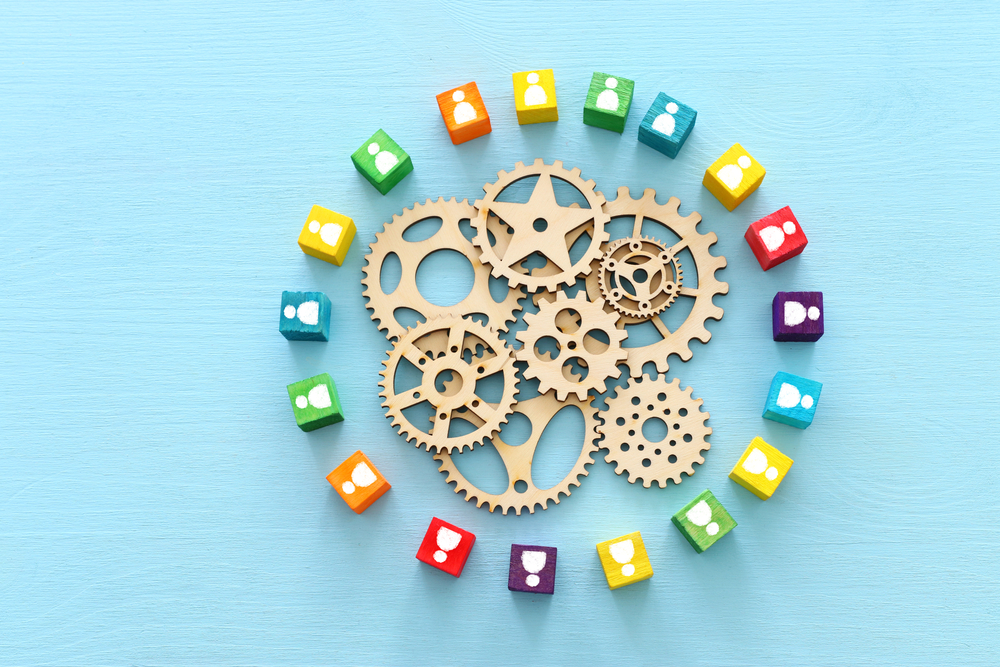
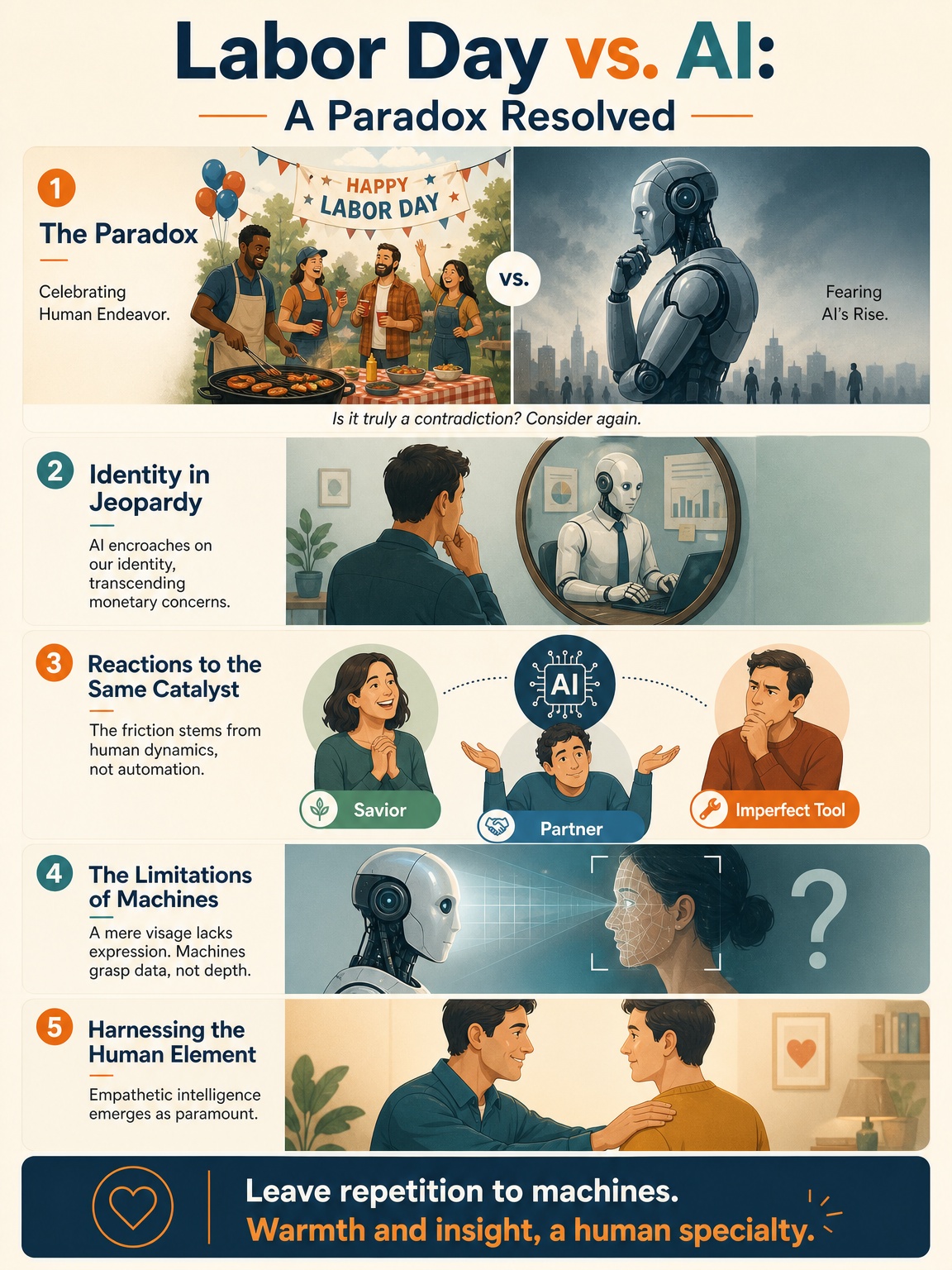
Every year, Labor Day arrives with parades, backyard barbecues, and a collective exhale. It is a holiday built to honor human work: the sweat, the skill and the dignity of showing up and getting things done. Yet in recent years, a strange tension has crept into the celebration. We pause to salute human labor at the very moment that artificial intelligence seems poised to reshape, and in some cases replace, that labor. Celebrating workers while quietly fearing their obsolescence feels like an oxymoron. How do we toast the value of human effort when the headlines whisper that machines might soon do it better?
This tension is worth sitting with, because it reveals something important about AI in the workplace and about ourselves. The relationship between Labor Day and AI is not a simple story of humans versus machines. It is a more nuanced story about identity, meaning, fear and the distinctly human capacities that no algorithm has managed to replicate. Chief among those capacities is emotional intelligence, and it may turn out to be the very thing that resolves the apparent contradiction.
Labor Day was born from a labor movement that fought for the worth of the worker. Its entire premise rests on a belief that human effort matters, that it deserves recognition and protection. So when we layer onto that holiday a growing fear of job displacement driven by AI, the celebration starts to feel hollow to some. Are we honoring a way of working that is on its way out?
Recent scholarship suggests the fear is real but often misdirected. In their comprehensive study AI Disruption at Work, Oksanen and Savolainen (2026) draw on longitudinal, cross-national data spanning six continents to examine how workers actually experience the arrival of AI. Their findings complicate the doomsday narrative. Yes, AI workforce anxiety is measurable and rising. Worries about AI replacing human work climbed sharply after late 2022, when generative AI tools entered mainstream use. But the researchers found that fear of displacement does not automatically translate into rejection of the technology, nor does it reliably predict actual job loss. The story is far messier, and far more human than a clean tale of substitution.
That messiness is exactly where the oxymoron begins to dissolve.
The fear of AI is rarely just about paychecks. Oksanen and Savolainen (2026) make a compelling case that AI provokes something deeper: an identity threat. Work is not merely how we earn a living. It is a core part of how we understand ourselves. When an algorithm can suddenly write the code, draft the copy or analyze the data that once defined your expertise, the challenge is not only economic. It is existential. Who am I, if the thing I was good at is now automated?
The researchers document this vividly through the case of Hollywood screenwriters, whose 2023 strike was, at its heart, less about wages than about professional identity and the meaning of authorship in an age of generative machines. Their study shows that AI-related stress rises most sharply when the technology encroaches on tasks that were previously understood as uniquely human. Interestingly, they also found that supervisors and those in positions of authority often reported higher perceptions of threat, while entrepreneurs reported lower ones. Fear, in other words, is not evenly distributed. It tracks with how much of our sense of self is bound up in the work being changed.
This is precisely where emotional intelligence enters the picture. If the deepest wound of AI is an identity wound, then the balm is not a better algorithm. It is the human capacity to recognize, understand and manage emotions, both our own and others'. Emotional intelligence in the AI era is not a soft add-on. It is a load-bearing pillar of how workers and organizations weather the transition.
One of the most persistent assumptions about AI in the workplace is that it will cleanly take over human tasks. Reality, it turns out, is stubbornly resistant to that tidiness. Einola and Khoreva (2022), in their in-depth study Best Friend or Broken Tool?, spent months embedded in a technology-savvy media company implementing multiple AI solutions. What they discovered upended the standard script.
Different groups within the same organization made sense of AI in wildly different ways. Executives spoke of AI as a "savior" and an inevitable path to survival. Managers framed it as a "horn of plenty" for boosting sales. Digital media employees treated it as a natural, almost invisible extension of their work, "my closest colleague," as one put it. But traditional media employees experienced the very same rollout as a "broken tool," a "stupid" robot that created more work than it saved and demanded constant supervision.
Crucially, Einola and Khoreva found no evidence of workers fearing wholesale job loss. There was plenty of work to go around. What they found instead was friction, frustration and change fatigue: the exhaustion of learning yet another poorly functioning system layered on top of an already demanding job. The tension in the workplace was not between humans and machines. It was between humans, between groups who understood the technology through radically different emotional and cognitive frames.
This finding is a gift for anyone trying to navigate human-AI coexistence. It tells us that the make-or-break factor is not the sophistication of the technology but the quality of human sensemaking, communication and relationships around it. Managers who dismissed employee resistance as mere "reluctance to change" missed the real story entirely. Those with the emotional intelligence to listen, to understand the lived experience of frustrated workers, and to recognize the tacit knowledge those workers held were the ones who could actually make the coexistence work.
Part of what fuels AI workforce anxiety is an exaggerated belief in what machines can perceive and understand. Here, the science offers a useful corrective. Barrett and colleagues (2019), in their landmark review Emotional Expressions Reconsidered, dismantled a widespread assumption that underpins much of today's emotion-detecting AI: the idea that human emotions can be reliably read from facial movements.
Their exhaustive analysis concluded that there is no simple, universal mapping between a facial configuration and an emotional state. A scowl does not reliably mean anger. A frown does not reliably mean sadness. As they put it, when it comes to emotion, a face does not speak for itself. Emotional meaning is deeply dependent on context, culture and the individual. This matters enormously for the future of work, because it exposes the limits of AI systems that claim to gauge human feeling. If even the most advanced software struggles to interpret the meaning behind a human expression, then the rich, contextual, relational work of genuine emotional understanding remains firmly in human hands.
This is the quiet reassurance buried in the Labor Day paradox. The very capacities that emotional intelligence encompasses, reading a room, sensing unspoken fear during a restructuring, understanding why a colleague resists a new tool, offering authentic reassurance, are precisely the capacities that resist automation. Barrett and colleagues remind us that emotion is not a fingerprint to be scanned. It is a lived, contextual human experience. And that experience is the terrain where human workers retain a durable advantage.
Pull these three bodies of research together and a coherent picture emerges. Oksanen and Savolainen show that AI's deepest impact is on identity and stress, and that social support at work buffers that stress more effectively than technical training does. Einola and Khoreva show that successful AI adoption hinges on human sensemaking and relationships, not on the technology alone. Barrett and colleagues show that genuine emotional understanding cannot be outsourced to machines.
The common thread is emotional intelligence. In an era of rapid technological change, the ability to manage one's own emotional response to uncertainty, to empathize with colleagues navigating identity threats, and to communicate with honesty and care becomes the scarce and valuable resource. Oksanen and Savolainen found that social support from colleagues and supervisors significantly reduced AI related stress. Supportive, transformational leadership strengthened workers' confidence in learning new tools. These are not technical interventions. They are emotional and relational ones.
So perhaps Labor Day and AI are not the contradiction they first appear to be. Perhaps the holiday is actually pointing us toward the answer. By honoring human work, we are implicitly honoring the human capacities that make that work meaningful and irreplaceable. Chief among them is our capacity for connection, empathy and emotional understanding. The machines can handle the analysis and the routine. What they cannot do is care, and caring is quietly becoming the most important job skill of all.
The fear of job displacement is understandable, and it deserves to be taken seriously rather than waved away with cheerful platitudes. Real transitions are underway, and some roles will change or disappear. But the research consistently suggests that the future of work is not a story of humans being erased by machines. It is a story of coexistence, negotiation and adaptation. Its one in which emotional intelligence functions as both a coping resource and a competitive edge.
Labor Day, then, need not be an oxymoron in the age of AI. It can be a reminder of what endures. We celebrate human labor not because machines will never touch it, but because the meaning, dignity and emotional richness we bring to our work are ours alone. The barbecue smoke and the parades honor something an algorithm cannot replicate: the human heart that shows up to the work.
So here is the question worth carrying with you as the long weekend winds down: If the parts of your work most vulnerable to automation are stripped away tomorrow, what uniquely human capacities would remain, and have you been investing in them as deliberately as you have in your technical skills?